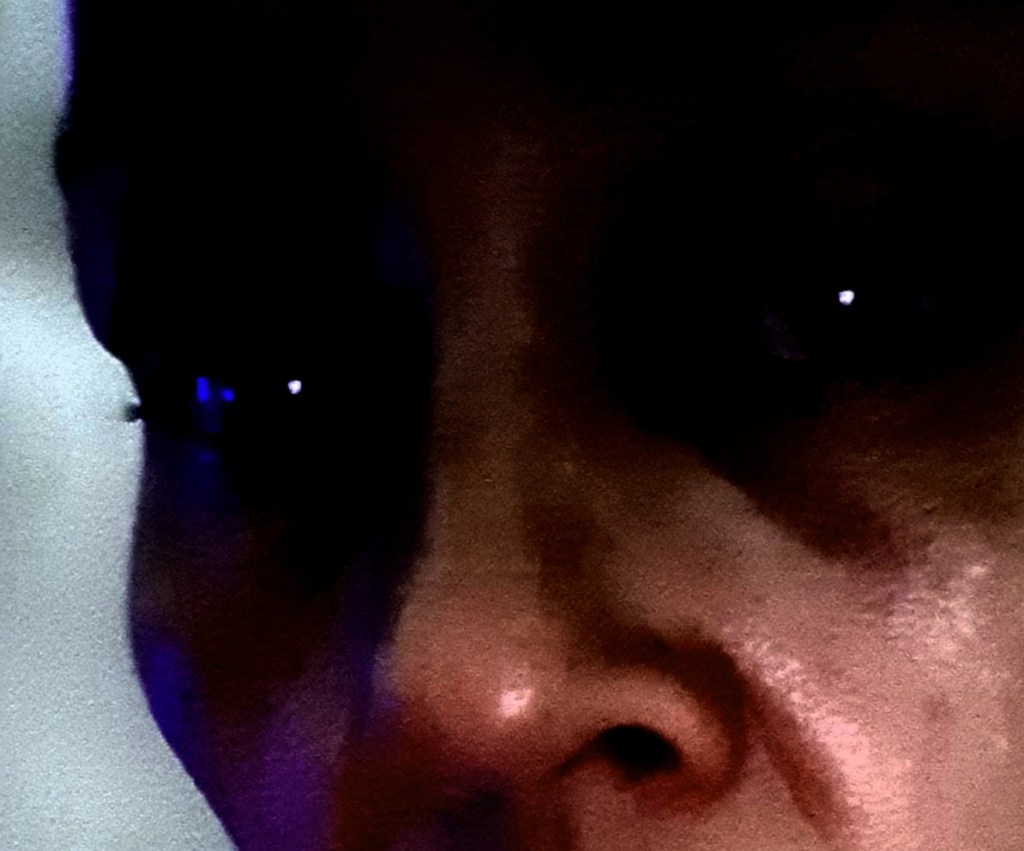
Brightest lights. White walls. White floors. White sheets. White stiff cloth on people who bustled about. Blurring and clearing in and out of my vision. And silver shining. Silver rails at the sides of the table I was on. Silver instruments on silver trays with silver legs. White and silver glared and glistened harsh and it was so cold.
Pushing from inside, a want to get up and run. Out the sliding glass doors I saw occasionally open. But something impaired. I struggled to get up, but could not. I tried again and again and it took a few attempts before I realized it was not something physical holding me down, I was not stuck in some sort of jelly, as it felt, but was somehow mentally unable to function. I could not command my body. Panic rushed through me as it dawned, I had been drugged.
I knew I had to overcome the drugs I had been given by my strength of will. I knew my life depended on it. I knew that if I could not get out without being noticed that I would have to fight my way out. I began to get off the bed but was so clumsy about it I was noticed before I could get both feet on the floor. The one who noticed called for help as she rushed anxiously toward me and eased me back down. She was able to ease me down, because the mere effort of sitting up and getting one leg swung around the side of the table had exhausted me to the point that I could no longer sustain even the panic. My body shut down and I faded into unconsciousness.
There were times, moments, muffled or warbled voices. Other times shadows passed across my eyelids. Once, I recognized the blood pressure sleeve tightening on my upper arm and clearly heard the voices of the nurses. They spoke of the implausibility of my continuing survival.
“She still here?”
“Yeah. But she’ll never make it.”
In my head a thought came as a scream; I can hear you! But I couldn’t move. I tried desperately to communicate with them. I used all my might, all my concentration, to attempt to move a finger. Couldn’t. I planned. I plotted. I came up with the idea that the next time they came close, I would blow, puff, or somehow exhale to indicate my cognition.
The attempt failed. Doleful washed as their sounds faded. Then I realized that I hadn’t released the sigh that should have come naturally along with this deep discouragement. Then noticed, even the rhythm of my breathing was not in my control. Fear rushed. Tired me. I gave up the conflict and thought, as I drifted off, of the signature on my driver’s license to donate my organs and hoped I would not be so aware if that came to fruition.
I suppose over time my blood regenerated some, because all at once I sat straight up, easily flung my legs around, took a breath to summon my strength and hopped off the gurney. A small mob of nurses pushed me back down. I was still weak, but now angry. A hostile resolve to leave could not be restrained by three of them. This elicited the attention of a young doctor with curly brown hair.
He approached me directly.
“What’s your name?”
I was thrown. Thoughts spun like a disjointed carnival ride. My name? Well, of course. I know that. It’s … it’s … uhh … it’s … Name. Yes. I know this. Sue. Yes! That’s it!
“Sue!”
I almost shouted. I was beaming with the thrill of having come up with it. My name. Sue. Yes. I was quite confident about that.
This genteel man then became an inquisitor with a bothersome barrage of somewhat troubling questions.
“Sue what?”
“Huh?”
“What’s your last name, Sue?”
Stumped, I smiled coyly.
“You, sir, ask very difficult questions.”
He was unfazed.
“What year is it?”
I felt the surprised and puzzled expressions on my face before I recognized the feelings. I examined the feelings. The surprise was that I was puzzled. I was thinking, I should know this. There was a time when I knew this. Was it yesterday? I can’t remember yesterday.
I took a stab.
“1862.”
That seemed right.
By their faces I could tell, I was off by a century or so.
“1962?”
He shook his head.
“1964?”
“You’re getting closer, but let’s move on. What state are you in?”
Dumbstruck.
“Can you name a state?”
I could picture the outline of the United States, but I couldn’t name it. I searched my brain and imagined the shape and sought a name from within it. They waited. Watched me struggle. Finally, an answer came like an explosion.
“Dakota!”
This seemed somehow to appease the gathering of curious onlookers and they dispersed, leaving one nurse and the young doctor behind. He pronounced that I had amnesia. I thought, Gee, I don’t know my name and I could have called that one.
Over the course of a few hours, I had a variety of outbursts when I came to. Sometimes I was hell bent on escape from the apparent cult my boyfriend, who hovered on the edge of the scene, had sacrificed me to. Other times I had no idea who he was.
“No. I don’t know him.”
He looked so sad. I added, “Maybe he’s a friend of Ron’s.”
Then he looked angry.
“Who’s Ron?”
Sometimes I just wanted out. I was so near the doors. A few times I attempted to make for them.
The doctor came to me and asked why I was so insistent on leaving.
“I just want to.”
He was tickled.
“You don’t know who you are. Where do you intend to go?”
I lifted a finger pointed toward the doors, marginally wobbling.
“I don’t know, but from the looks of things, I’m in a jail or a hospital and either way, I want out.”
I wasn’t the only one disagreeable. A large, white-clad woman shook a chunky finger in my face while lecturing me on the consequences of drinking and driving. I grabbed her starchy shirt and threw her onto one of the nearby wheeled trays, bouncing a shattering sound off the walls as the instruments flew, while I growled, “I wasn’t driving.”
I jumped off the gurney and headed for the door.
Two steps and they had me back down.
This brought the doctor back. He squatted down a bit, leveled off with me, eye to eye, put one hand on each of my knees.
“Sue.”
He got my attention when he used my name, the only thing I knew.
“You have a serious head injury. We can’t let you leave.”
I lifted my hand to my forehead and touched my fingers to the gaping gash above my eye. I felt the odd sensation of the pressure of my fingertips on my sticky exposed skull. The skin hung unnaturally with loose edges in folds around my fingers.
“Oh, this?” I waved my hand out casually. “That’s nothing.”
Blood flew off the ends of my fingers through the air. It struck curious. I examined my hand. More blood. And all the way up my arm. My gaze fell to my shirt. Blood drenched. I raised my hand to my hair. It had become curly, as it did when wetted, and I felt the thick, gooey mess. This was all blood. A very large amount of blood. I nearly fainted in horror and dropped back heavily onto my elbows.
I sat back up and looked at him beseechingly. Our eyes met. Locked. Searched. He paused and leaned back, cradling his chin between the thumb and fingers of one hand, crossing the other over his chest and holding his elbow. After a moment this way, he looked at his watch.
“Well, you’ve made it eight hours. I guess we’ll sew that up.”
He called a nurse over and she found me cooperative, since now I reeled with the knowledge of the gravity of my injury, the amount of blood, my jeans caked with dried blood, soaked through to my thighs, the skin of my thighs stuck to the cloth with it. I was no longer bleeding and wondered if that wasn’t just because I had run out of blood. This made more sense of the weakness. And the head injury he reported explained the memory loss. I pondered these subjects dreamily until I felt a pain so sharp and piercing that it seemed to go straight through my brain and to the base of my skull.
“Sorry, I just need to get this piece.”
I tried to relax and be still and let her do her work. But, again, the pain was more than I could bear. “STOP,” I snarled as I grabbed her wrist and pushed it away. I leaned forward, unsteady, trying to keep vomit down, to remain conscious, and with a throttlehold on her arm.
The doctor, who knew my name and used it, appeared. The nurse pointed with her tool to a piece of glass she couldn’t get.
“See, this one, I can’t quite…”
When she began to prod again I didn’t at first recognize that the guttural cry I heard was coming from inside me.
“That’s her skull!” Then he groaned, “I’ll take it from here.”
I was so relieved to have him take it from there. He had stopped the overwhelming pain she had caused. He knew my name and used it. He was the man who had declared I would live. He introduced me, later, to my mother in such a way as to spare her the immediate knowledge of the depth of my amnesia.
“Here’s your mother, Sue.”
I followed his lead.
“Hi,” the sentence hung there as I tried to recall whether it was mother or ma or mom or mommy. She was too distracted by the rest to notice.
Over the next couple of days, the doctor and I enjoyed our time together, when he came in during his rounds. We bantered about our opposing views on how long I should stay. He explained details of subdural hematoma, the bouncing, the bruising, the bleeding of my brain. He told me that is why they pushed me aside after the CT scan because there was nothing they could have done. He said this is why they needed me to stay for six weeks of observation. I absolutely refused that. He suggested three.
“Tell you what, give me a business card. If any blood starts oozing out of my ears or anything, I’ll give you a call.”
“Why do you want to leave so badly? You don’t even know where you live.”
I pointed to a woman standing across the room.
“You said that’s my mother and I bet she knows where I live. Let me go.”
His expression became serious while he informed me that ninety-five percent of the people with a head injury such as mine die immediately.
“So, I’m the other five-percent. So, let me go.”
He shook his head.
“You don’t understand. The other five-percent are comatose until they die.”
We paused. He waited for me to understand the seriousness. I lingered. I was impressed. I understood his concern. I sympathized. It was just, I felt fine and I didn’t like restraint. Besides, they wouldn’t let me eat and I was starving. And I knew that when they did it wouldn’t be enough. I desperately wanted a big, sloppy hamburger and fried zucchini with ranch.
“Doc,” I leaned forward. “I gotta go.”
A mix of indignation and burden on his face. He slowly and deliberately approached me. He even more slowly and deliberately spoke.
“That you are sitting up in bed and speaking is medically impossible. I can’t explain it.”
I couldn’t either. His authority left me dumbstruck. I only had a sense, so said it.
“Sturdy peasant stock.
2005 Southern Illinois Writers’ Guild competition 2nd Place Essay.
Photo credit: Ranney Campbell, 2022



 The Life You Could Have: a memoir